Warum wir abhängiger sind als wir denken: Michael Seemann – Midst of Mind Podcast #33 – YouTube

Gabriel vom Midst of Minds Podcast hatte mich zum Gespräch gebeten und naja, was soll ich sagen, ich hab einfach mal drauf losgelabert und praktisch meine ganze Theorie in anderthalb Stunden erklärt und am Ende wurde es ziemlich apokalyptisch.

Digitale Infrastruktur prägt, wie wir denken, kommunizieren und Entscheidungen treffen. In dieser Folge sprechen wir über Plattformmacht, Netzwerkeffekte und die Abhängigkeiten, die durch technologische Systeme entstehen. Dabei geht es nicht nur um Big Tech, sondern um grundlegende Strukturen, die Gesellschaft, Wirtschaft und Politik beeinflussen. Wir diskutieren, wie Sprache selbst zu einer Infrastruktur wird, warum das Individuum zunehmend in größere Systeme eingebettet ist und welche Risiken fragile dig

Krasse Links No 83

Willkommen zu Krasse Links No 83. Sattelt euer Alltags-YOLO, heute berechnen wir die Attention Debt von U_scheitert des mimetischen Begehrens im Greenspan Put.

Nachtrag: Die Folge vorgelesen von Ali Hackalife. (€)


Palantir hat auf X eine Art Manifest (Eher das, was wir früher einen „Twitter-Meltdown“ nannten) aufgeschrieben und es ist neben dem Manifest von Andreesen die vielleicht klarste Ausformulierung des Tech-Faschistischen Programms.

Bestehend unter anderem aus unapologetischem Militarismus und kalter Gewaltverherrlichung.

4. The limits of soft power, of soaring rhetoric alone, have been exposed. The ability of free and democratic societies to prevail requires something more than moral appeal. It requires hard power, and hard power in this century will be built on software.

Natürlich gepaart mit KI-Hype.

12. The atomic age is ending. One age of deterrence, the atomic age, is ending, and a new era of deterrence built on A.I. is set to begin.

Einer konkreten „Schlussstrich“-Aufforderung für Europa.

15. The postwar neutering of Germany and Japan must be undone. The defanging of Germany was an overcorrection for which Europe is now paying a heavy price. A similar and highly theatrical commitment to Japanese pacifism will, if maintained, also threaten to shift the balance of power in Asia.

Einer weinerlichen Verteidigung von Elon Musk.

16. We should applaud those who attempt to build where the market has failed to act. The culture almost snickers at Musk’s interest in grand narrative, as if billionaires ought to simply stay in their lane of enriching themselves . . . . Any curiosity or genuine interest in the value of what he has created is essentially dismissed, or perhaps lurks from beneath a thinly veiled scorn.

Und einem ausgesprochenen Kulturchauvismus.

21. Some cultures have produced vital advances; others remain dysfunctional and regressive. All cultures are now equal. Criticism and value judgments are forbidden. Yet this new dogma glosses over the fact that certain cultures and indeed subcultures . . . have produced wonders. Others have proven middling, and worse, regressive and harmful.

Nach Trump wird das die nächste dominante Agenda, vertreten von Vance, Rubio und den Broligarchs. Und in Europa wird man aufatmen und sagen, „die Erwachsenen sind zurück“ und alle Verträge unterschreiben, die ihnen vorgelegt werden.


Raffi Krikorian war mal Manager bei Uber und ist jetzt bei Mozilla und schreibt im Atlantic über den Unfall, den er mit seinem Tesla Autopilot hatte.

One Sunday last fall, my kids and I were on a drive we’d done hundreds of times, winding through the residential streets of the Bay Area to drop my son off at his Boy Scouts meeting. The Tesla was in Full Self-Driving mode, driving perfectly—until it wasn’t.

Wir hatten neulich bereits darüber gesprochen, dass die menschliche Q-Function für KI-Pfade kaputt ist. Es gibt eine Art „Cognitive Surrender“ gegenüber den Ergebnissen von Chatbots. Dasselbe gilt für selbstfahrende Autos und heißt hier „vigilance decrement“.

Full Self-Driving works almost all of the time—Tesla’s fleet of cars with the technology logs millions of miles between serious incidents, by the company’s count. And that’s the problem: We are asking humans to supervise systems designed to make supervision feel pointless. A machine that constantly fails keeps you sharp. A machine that works perfectly needs no oversight. But a machine that works almost perfectly? That’s where the danger lies. After a few hours of flawless performance, research shows, drivers are prone to start overtrusting self-driving systems. After a month of using adaptive cruise control, drivers were more than six times as likely to look at their phone, according to one study from the Insurance Institute for Highway Safety. […]

Psychologists call this the vigilance decrement. Monitoring a nearly perfect system is boring. Boredom leads to mind-wandering. The research is unforgiving: Drivers need five to eight seconds to mentally reengage after an automated driving system gives control back. But emergencies can unfold much faster than that. The driver’s physical reaction might be instantaneous—grabbing the wheel, hitting the brake. But the mental part? Rebuilding context, recognizing what’s wrong, deciding what to do? That takes time your brain doesn’t have.

In dieser Lücke zwischen dem voreiligen Vertrauen in die Technik, der habituell übertragenen Kontolle und der verlernten Möglichkeit des Eingriffs, sitzt die größte Gefahr des Unfalls. Auch Krikorian zieht die Parallele zu Chatbots.

My car didn’t warn me when it was confused. Chatbots don’t, either; they deliver their results in the same confident voice, whether they’re right or hallucinating. They perform expertise, even when the sources they cite are dubious or fabricated. They use technical language in an authoritative tone. And we believe them, because why wouldn’t we? They’ve been right so many times before.

Cars train us mile by mile; AI trains us week by week. In week one, you read a chatbot’s output carefully. By week three, you’re copying and pasting without reading. The errors don’t disappear, but your vigilance does. So does your judgment, until one day you realize that you can’t remember which ideas in a memo were yours and which were generated by AI. What does it say about us that we’ve handed over our thinking so willingly?

Wenn der Autopilot scheiße baut, passiert ein Unfall. Die Unfälle, die wir von KIs erwarten können, werden sich strukturell unterscheiden, weil die Fehler erstmal nicht auffallen und sich im Portfolio unserer unbewussten Wetten als „Attention Debt“ aufaddieren – bis es kracht.

When my car failed, it was immediate and palpable. With chatbots, the failure is silent and invisible. You find out about it later, if at all—after the email is sent, the decision made, the code shipped. By the time you catch the mistake, it’s already out there with your name on it. When the system works, you look efficient. When it fails, your judgment is questioned, sometimes with catastrophic consequences. In 2023, a New York lawyer was sanctioned for citing six cases that didn’t exist. ChatGPT had invented them, but he’d trusted it, and the court blamed him, not the tool. Because a chatbot never gets fired.

We’re experiencing an uncanny valley of autonomy. Computer systems aren’t just almost human; they are almost capable of working on their own. When they fail, someone has to absorb the cost. Right now, that someone is us. But when we pay for a self-driving car or an AI tool, we think we’re buying a finished product, not signing up to test a work in progress.

In der Politischen Ökonomie der Pfadgelegenheiten suche ich immer nach der Q-Function. Q-Function ist ein Begriff aus der KI-Forschung und bezeichnet den „Wert“ einer Pfadgelegenheit innerhalb eines Status eines Spiels. Think Schach: Wie „gut“ ist dieser Zug im Kontext des aktuellen Spielbretts?

Ich versuche immer den Mathepart einfach zu halten, deswegen war meine erste Annäherung:

F(Q) = p x U

wobei „p“ für die Übergangswahrscheinlichkeit steht (mit Werten zwischen 0 und 1), mit der die Pfadgelegenheit gelingt und „U“ für den Nutzen, der sich aus der gelingenden Pfadgelegenheit ergibt, wobei U wiederum eine Abschätzung ist, welche anderen Pfadgelegenheiten durch die betreffende Pfadgelegenheit erreichbar werden, deren Q-Functions also wiederum in die originale Q-Function mit einfließen (So ein bisschen wie bei der Bellman-Gleichung).

Bedenkt man aber, dass jeder Pfad auch ein Risiko beinhaltet, muss man die Formel erweitern. Etwa:

F(Q) = p × U_gelingt + (1−p) × U_scheitert

Wir trennen den Erfolg entlang der Übergangswahrscheinlichkeit p von dem Misserfolg, so dass in den Fällen, in denen die Pfadgelegenheit mißlingt, auch eine andere Nutzenfunktion gilt.

U_scheitert ist im Alltag oft einfach 0 und wir denken den Wert kaum mit, denn wenn eine Pfadgelegenheit misslingt, dann ist der Standardfall, dass wir einfach keinen Nutzen aus ihr ziehen. Manchmal liegt U_scheitert auch zwischen 0 und U_gelingt, z.B. dann, wenn die Ruine des Scheiterns nützliche Infrastrukturen hinterlässt.

Aber dann gibt es noch eine ganze Reihe von Fällen, wo U_scheitert einen negativen Wert hat. Etwa beim Autofahren. Eine Autofahrt ist nützlich, ohne Frage, aber eine gescheiterte Autofahrt kann schnell teuer werden?

Und diesen Kosten sind kaum Grenzen gesetzt? Vereinfachen wir und sagen, die maximalen Kosten des Scheiterns einer Pfadgelegenheit ist der eigene Tod. U_scheitert wäre dann – ∞ (minus Unendlich).

Die Möglichkeit des eigenen Todes ist im Stassenverkehr nur allzu real und da fragt sich, wie man dann überhaupt noch daran teilnehmen kann?

Zum Beispiel, indem man p einfach aufrundet?

Und ich fürchte, das aufgerundete p ist das Alltags-Yolo, das jeden von uns am Laufen hält!

Wir lügen uns in die Tasche, dass wir „das Risiko abschätzen können“ und tun einfach so, als wüssten wir nicht, dass wir das gar nicht wissen können.

Es hilft dabei, U_scheitert gar nicht so genau in Betracht zu ziehen und hier liegt das eigentliche Problem: U_scheitert wird erst mit Schmerz konkret. Krikorian wird den Fehler (hoffentlich) nicht noch einmal machen, denn U_scheitert ist bei ihm von einer abstrakten Möglichkeit zu einer Erfahrung geworden.

Paul Virilio sagte mal, dass jede Technologie ihre eigene Art von Unfall produziert. Aber das kann dauern? Der Three Mile Island Vorfall ereignete sich erst 24 Jahre nach der Einführung der zivilen Atomkraft, wir stecken erst gerade mitten im Unfall von Social Media und die Wucht des Unfalls der Dampfmaschine rollt gerade erst so richtig auf uns zu. Es gibt immer eine Ungleichzeitigkeit zwischen Technologie und ihrer durch Schmerzerfahrung informierten U_scheitert-Funktion.

Und trotz des Füllhorns von Katastrophen, die die LLM jetzt schon auf die Gesellschaft loslässt, bin ich überzeugt, dass wir den eigentlichen Unfall des Transformermodells noch gar nicht gesehen haben.


Techpolicypress enthüllt die Lobbyerfolge der Techfirmen, die Umweltschäden ihrer Datencenter gegenüber EU-Regulierung unsichtbar zu machen.

The European Commission incorporated a secrecy provision drafted by Microsoft and tech lobby group DigitalEurope into European Union law, blocking public access to critical information on data centers‘ environmental impact, an investigation led by Investigate Europe, an independent journalism cooperative, in collaboration with Tech Policy Press, has found.

The confidentiality clause — inserted into a 2024 implementing regulation under the EU Energy Efficiency Directive (Directive 2023/1791) — shields information on energy use and water consumption from affected communities, researchers and journalists. Ten legal scholars told Investigate Europe it may violate the EU’s obligations under the Aarhus Convention, an international treaty guaranteeing public access to environmental information.

With the EU set to triple its data center capacity over the next five years, the European Commission collects key metrics like energy efficiency and water consumption from facilities. But information on individual facilities‘ footprint is kept secret, after the industry pushed to amend the legislation to classify it as confidential and commercially sensitive.

Jerzy Jendrośka, a professor of environmental law at Opole University, who spent 19 years on the compliance body overseeing the Aarhus Convention, said: „In two decades, I cannot recall a comparable case. „This clearly seems not to be in line with the convention.“

Das Resultat ist eine strategisch stillgestellte U_scheitert-Funktion, mit der man den p-Wert der KI-Wette einfacher aufrunden kann.

As a result, only broad, national-level data is made public, while information about the precise impact of individual data centers is kept out of reach of affected communities, academics, journalists and the wider public.


Vielen dank, dass Du Krasse Links liest. Da steckt eine Menge Arbeit drin und bislang ist das alles noch nicht nachhaltig finanziert. Im März haben sich meine Einnahmen wieder erholt (573,71,-) aber sind noch weit weg von meinem Ziel, also von den notwendigen 1.500,-. Mit einem monatlichen Dauerauftrag kannst Du helfen, die Zukunft des Newsletters zu sichern. Genaueres hier.

Michael Seemann
IBAN: DE58251900010171043500
BIC: VOHADE2H

Dieser Newsletter ist nicht auf Reichweite ausgelegt, aber will dennoch Menschen erreichen. Du kannst dem Newsletter helfen, indem du ihn Freund*innen empfiehlst und ihn auf Social Media verbreitest.


Der Ökonom Alex Imas hat sich lesenswerte Gedanken über den Arbeitsmarkt unter AGI-Bedingungen gemacht. Die Gedanken sind auch abseits einer vollen AGI-Erwartung wertvoll, denn eine gewisse strukturelle Transiton im Arbeitsmarkt lösen die LLMs bereits aus.

Er prophezeiht, dass

  1. alle Tätigkeiten automatisiert werden, die sich automatisieren lassen und dass
  2. die automatisierten Bereiche, Produkte, Services in den Budgets der Menschen marginalisiert werden,
  3. so dass sich die Budgets auf die wenigen nichtautomatisierbaren Bereiche verschieben, also dort, wo die Mensch-Präsenz unerlässlich ist.

Das lehren jedenfalls die Beispiele aus anderen Strukturwandel-Ereignissen.

Economics has a name for what happens when a new technology makes one sector dramatically more productive: structural change. The canonical example is agriculture. In 1900, about 40% of the American workforce was employed in farming. Today it’s less than 2%. Did people stop eating? No, if anything they’re eating much more. Large scale automation made farmers—and eventually factory farms—much more productive. Agricultural production boomed and prices fell. But because people can only eat so much, the share of income spent on food went down as people got richer, and workers moved to manufacturing and then to services. The simultaneous fall of prices and reallocation of labor to another sector led to the perhaps non-obvious result that the more productive, automated sector became a smaller share of the economy despite serving and producing more. The less productive sector (services) where costs had not fallen—and in fact have risen—became a larger part of the economy. This is known as Baumol’s cost disease

Er folgert daraus – wie viele andere – eine „Abundance“ von automatisierbaren Produkten eintreten wird und ich finde das grundsätzlich etwas wackelig, denn menschliche Arbeitskraft ist nicht der einzige limitierende Faktor für so eine Zukunft. Die allgemeine Verfügbarkeit von einer Vielzahl von Rohstoffen, Materialien, Vorprodukten und komplexen globalen Lieferketten wird einfach angenommen, dabei sind das historisch gewachsene Strukturen, deren Zukunftserwartung – zumindest aus meiner Perspektive – so wacklig ist wie nie.

Aber gehen wir die Abundance-These mal probehalber mit und schauen, worauf er hinaus will.

Um seinen Punkt zu machen, konstruiert er sich ein interessantes, soziales „Wert“-Modell, für das er die Theorie des mimetischen Begehrens von René Girard beleiht.

Here I think it’s useful to have a closer look at the determinants of human preferences and desire. Economists typically model demand as if preferences are formed in isolation; the “utility” I get from a good, service, or experience is determined by its hedonics (e.g., how good did the coffee taste, how quickly did I get the coffee after ordering it).2 This makes sense when people’s budget constraints bind when it comes to meeting basic needs, e.g., for food, shelter, and clothing. But once those needs are met, a different force starts to shape what people want, and even becomes dominant. René Girard called it mimetic desire: the idea that we don’t desire objects only for their intrinsic properties, but because other people desire them as well. We want what others want, and we want it even more when they can’t have it—for status, social capital, reputation, etc. Desire is not just a relationship between a person and an object; it is also a function of what other people desires.

Kristof Madarasz and I provided support for the mimetic dimension of preferences in the context of basic economic exchange. We first developed a formal model where a person’s desire for a good increases in how much others want it but can’t have it. This predicts that people will value things more when there’s genuine exclusion, when access for a specific object is scarce and others are left wanting. In our experiments, willingness to pay roughly doubled when subjects learned that a random subset of people would be excluded from the product (Figure 2 below), even though the product itself was identical. This wasn’t status signaling (subjects were anonymous) or a scarcity heuristic (exclusion was random). It was purely driven by a pure preference for having something others don’t.

Und tatsächlich lässt sich eine Verschiebung der Wertpräferenz hinsichtlich von KI Arbeitsoutput bereits messen.

We find that AI involvement undermines the perceived exclusivity of a good; objects with AI involvement are perceived as inherently reproducible and non-unique. People bid for physical art prints that varied in described AI involvement. Human-made artwork gained 44% in value from exclusivity (one copy vs. many), but AI-generated artwork gained less than half that, only 21%. The mere involvement of AI made the work feel inherently non-exclusive, as if it could always be reproduced, regardless of how many copies were said to exist.

Dazu kommt ein ebenfalls messbarer Effekt: Wenn dein Einkommen weniger von Überlebensnotwendigen Dingen aufgebraucht wird, verschiebt sich das Budget Richtung mimetisches Begehren.

As you get richer, a larger share goes toward goods where you’re not just buying the functional product; you’re buying the story, the scarcity, the feeling of having something that others want as well. This is what gives relational goods and services their high income elasticity: as incomes rise, the exclusivity premium becomes a larger share of total value, and that premium is something human-made goods can deliver.

Here’s the mechanism more precisely. When AI automates commodity production, prices in that sector fall. That raises real income. If the goods and services people want more of as they get richer lie disproportionately in the relational sector, demand shifts in that direction. Baumol’s cost disease then amplifies the result: if the relational sector remains harder to automate, it becomes relatively more expensive and absorbs a growing share of total expenditure.

„Slop“ ist gewissermaßen die absolute relationale Dematerialisierung: Produkte und Services, die ihre Abhängigkeiten von menschlicher Aufmerksamkeit komplett entkoppelt haben.

Daraus ergibt sich folgendes Bild für die Zukunft:

Material abundance from automated manufacturing means goods are cheap. Most people’s spending goes to human-led services: today’s luxuries become the baseline for future consumers. As commodity production gets automated, income and employment flow toward the sectors with high income elasticity: what I am calling the relational sector, including the arts but also care, education, hospitality, therapy, personal services, craftsmanship, and community, where the human element is part of the value.
Some already exist and are growing: nurses, therapists, teachers, boutique fitness instructors, personal chefs, bespoke tailors, craft brewers, live performers, spiritual guides, childcare workers, and many varieties of hospitality and care work. Others are emerging: experience designers, human-AI collaboration artists, provenance certifiers, community curators. Many haven’t been invented yet, just as six out of ten jobs people hold today didn’t exist in 1940.

In der idealen Konfiguration dieser Welt haben wir alle genug Geld, um genau einen anderen Menschen zu bezahlen, damit er uns wie ein Mensch behandelt. Aber so wird das ja nicht kommen?

Die mehr oder weniger kleine Gruppe von Menschen, die „noch gebraucht“ wird, wird ein sehr heterogenes Auskommen haben.

Es wird die Menschen, geben, deren Aufmerksamkeit sich nicht substituieren lässt und sie werden enorme Gewinne daraus ziehen. Und dann wird es eine viel, viel größere Gruppe geben, deren Aufmerksamkeit so austauschbar ist, dass auch ihre Margen knapp über den Reproduktionskosten liegen, etwa, wie wir es bei einem Großteil der Menschen, sehen, die heute bereits als Pfleger*innen, Künstler*innen und in anderen „menschenzentrierten“ Berufen arbeiten.

Und weil menschlicher Input jetzt schon oft in weitgehend automatisierten und relational dematerialisierten Infrastrukturen extrahiert wird (man denke an Mechanical Turk von Amazon, oder dem Heer an Clickworker*innen auf den Philippinen oder in Kenia), kann man davon ausgehen, dass eine Menge Produkte und Services nur auf dem Papier automatisiert sind, aber auf dem Fulcrum bereitgestellter Mikro-Aufmerksamkeits-Ströme eines austauschbaren Arbeitsheers hebelt. (Eine Zukunftsvision, die komplementär ist zu den vielen Lagern, die derzeit überall aus dem Boden sprießen …).

Und was passiert mit dem Heer der Menschen, deren Aufmerksamkeit gar keinen ökonomischen Wert mehr hat, außer den ihrer Daten, die von den KI-Systemen aufgesogen werden, um sie ihnen als billigen Slop zurückzuspiegeln? Wird man es dabei belassen, sie in der semantischen KI-Umschließung ihrem vollautomatisierten Schicksal zu überlassen?

Vielleicht schon. Jedenfalls so lange, wie ihre Körper keinem Datencenter im Weg stehen.


Dan Olson hat einen Video Essay darüber gemacht, warum er zu Mr. Beast ins Studio eingeladen wurde. Spoiler: Man erfährt es nicht, aber dafür eine Menge über den seelenlosen, Datengetriebenen und oft himmelschreiend ineffizienten Unsinn, den diese Leute da inszenieren. Unter anderem wird klar, dass die Methode Beast bereits aufhört, zu funktionieren.
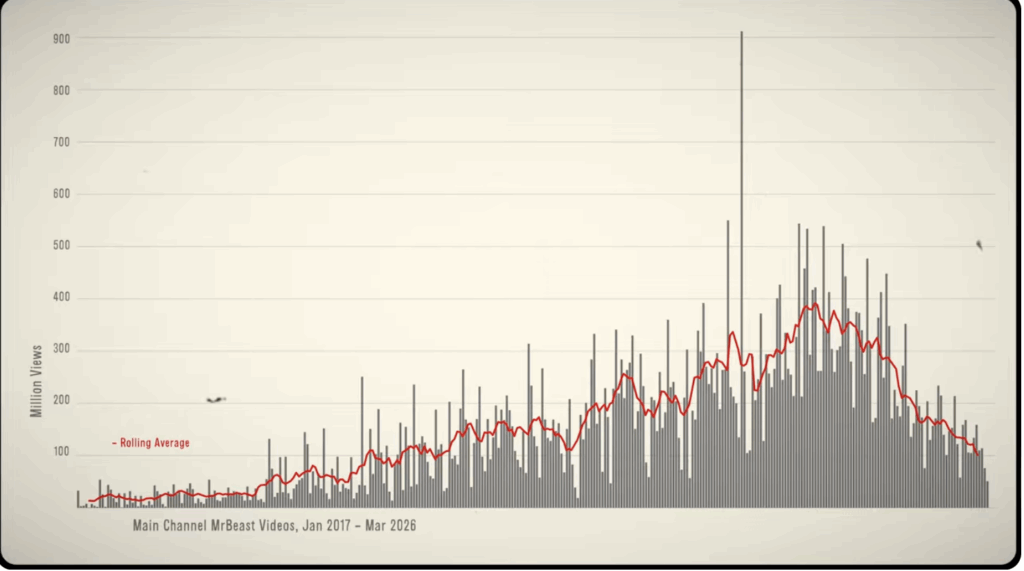
Was Olson sehr gut herausarbeitet, ist, wie die Daten-Obession beim Beast Team dazu geführt hat, dass sie einfach immer schlechteren Content produzieren. Die ständige Jagd nach Rekorden und Viewcounts zerstört Storylines, schafft enorme Ineffizienzen und engt die Kreativität ein. Wenn eine Sendung komplett im Autopilot des Feedback-Loops zwischen Youtube-Algorithmus und Daten-Dashboards produziert wird, dann nimmt man sich wie Krikorian im Tesla die Möglichkeit, rechtzeitig ins Lenkrad einzugreifen.


Kyla Scanlon fragt sich in der New York Times ob die Finanzmärkte den Verstand verloren haben..

The stock market has been trying to ignore the war in Iran. That’s been true over weeks of escalation and de-escalation, cease-fires, a blockade, and a blockade of a blockade (now just a U.S. blockade). Markets have barely flinched, even as crude oil prices swing wildly each day and the world’s supply chains begin to shake.
The word to describe what is happening is “shrug.” The problem is not a lack of information. There is too much information, arriving in late-night social media posts and endless push notifications. These days when I see “Breaking News,” it feels like there’s an emphasis on “breaking,” in the sense of “Things are broken.”

Das, was zerbrochen ist, ist das Bewusstsein, dass die Wette schief gehen kann. Denn Papa Staat steht am Ende doch da und fängt alle größeren Akteure auf (too big to fail), nicht?

More broadly, the markets are showing the single lesson that the past 40 years have taught them.

It will always be saved.

Markets are not properly pricing risk, because they really don’t have to. They have assumed that the U.S. government will not allow them to implode, and that assumption is putting the world economy at stake. What’s more, the new rescuer investors are counting on — artificial intelligence — is vulnerable to the exact risks markets are ignoring.

When Paul Volcker took the reins of the Federal Reserve in 1979, he showed that the central bank was willing to use rates as a blunt instrument. He hiked the federal funds rate above 20 percent to crush inflation, deliberately inducing a recession. It was brutal and effective, with unemployment rising and inflation cratering. His efforts saved the economy by destroying it, while establishing the precedent that the Fed could and would move the economy.

Alan Greenspan imparted the same lesson, but in an inverted way. Where Mr. Volcker disciplined markets, Mr. Greenspan rescued them. When the stock market crashed in October 1987, on a day known as Black Monday, Mr. Greenspan flooded the system with liquidity and cut rates.

Die Bailout-Erwartung ist inzwischen das zentrale stabilisierende Fulcrum aller Finanzwetten der großen Akteure und diese Bailout-Erwartung kann dafür eine beachtlich lange Historie beleihen.

That implication has a nickname — the “Greenspan put.” The implicit understanding (never written or formalized) is that the Fed would ease monetary policy whenever asset prices fell hard enough. It was necessary in many situations, but it also created a reflex.

For example, in 2008, Ben Bernanke, then the Fed chair, took rates close to zero and carried out three rounds of quantitative easing in response to the financial crisis. The Fed deployed trillions of dollars in asset purchases at a staggering scale and became a direct buyer in markets.

U_scheitert ist nach all den Jahren des Greenspan-Puts nur noch ein verbleichendes Schwarzweißfoto im Familienalbum des letzten Jahrhunderts und die Bailout-Erwartung ist bereits so ausgeprägt, dass sie selbst bei kleineren Hickups eingefordert wird.

The markets came to expect a form of salvation. In fact, markets expected so much support that they threw what were called “tantrums” when they didn’t get it — as in 2013’s “taper tantrum,” when Mr. Bernanke suggested (suggested) that the Fed would be buying up fewer bonds. The bond market freaked out, with the 10-year yield jumping from 2 percent to 3 percent in a few months, setting off a cascade of depreciation in emerging-market currencies. The markets learned: They could demand rescue.

Then Covid happened. Both Congress and the Fed deployed trillions in combined and coordinated fiscal and monetary support within weeks at breakneck speed and scale. The stock market hit all-time highs within months of the worst economic shock since the Great Depression.

Doch, ob das stablisierende Fulcrum des Greenspan-Puts im Falle eines Crashs „hält“, ist heute mehr als fraglich?

The problem is that the rescue infrastructure is exhausted. The Fed is trapped. Inflationary pressures mean that rate cuts, the most powerful tool in the monetary tool kit, could risk making things worse. The Greenspan “put” is not really in the cards.

Fiscal policy is equally constrained. U.S. debt levels have reached a point at which any new spending programs face real limits. The dollar’s role as the global reserve currency is showing cracks. Foreign holders of Treasuries are watching U.S. policy with increasing skepticism.

Während also auch hier „p“ durch Narkotisierung von U_scheitert aufgerundet wird, basiert die gesamte Zukunftserwartung von U_gelingt auf der Ankunft von AGI.

The only real backstop, if you look at where the money is going, is artificial intelligence.

This reliance on A.I. looks like an extraordinary concentration of bets. The Magnificent 7 (Google’s parent, Alphabet; Amazon; Apple; Facebook’s parent, Meta; Microsoft; Nvidia; and Tesla) are over 30 percent of the S&P 500, up from about 12 percent a decade ago. The four largest hyperscalers — Alphabet, Microsoft, Meta, Amazon — are projected to spend nearly $700 billion combined in 2026 on A.I. infrastructure, an increase of more than 60 percent from last year, and are spending so aggressively that they’re likely straining their cash cushions.

The implicit argument embedded in current valuations across both public and private markets is that A.I. will be productive enough to offset an economic downturn as the economy loses jobs from A.I. The valuations also suggest that the A.I. industry will be efficient enough to navigate an energy crisis with the knowledge to reroute supply chains disrupted by, say, war. […]

This redirects moral hazard from “the Fed will bail out the banks” to “the government will bail out A.I.” Call it the A.I. put — and this isn’t a critique of A.I. companies. They are responding to the incentives of a favorable policy environment.


Aber was würde das überhaupt bedeuten, dass die KI-Wette aufgeht? Wie sieht eine U_gelingt-Welt aus, in der sich die exorbitanten Summen gerechnet haben, die bereits in KI investiert wurden?

Ricardo Hausmann and Andrés Velasco untersuchen im Project Syndicate, welche ökonomischen Realitäten hergestellt sein müssten, um die bereits jetzt investierten Milliarden profitabel zu machen.

Is the AI boom a bubble? No one can be sure. But one way to answer that question is to ask a more manageable (and more interesting) one: What kind of world economy would have to emerge for today’s market valuations to make sense? Consider the core group of firms at the center of the AI story: Nvidia, Alphabet, Apple, Microsoft, Meta, Broadcom, Tesla, OpenAI, Anthropic, SpaceX-xAI, and Amazon Web Services. Taken together, they embody a remarkable market wager. Under a conservative benchmark—that by 2036 these firms trade at price-earnings ratios of 20, earn net profit margins of 20%, and obtain 65% of their incremental revenue from abroad — in a decade they would generate roughly $2.4 trillion in additional annual foreign revenue. Such revenue is roughly equal to all US goods exports today and over twice the US current-account deficit.

Granted, the United States will have to import some inputs (like semiconductors) to provide those AI services. And not all rents will accrue to Americans, because foreigners also hold shares in US tech companies. But the offset is likely to be small: foreigners reportedly own just 15–20% of the S&P 500 stock index. These striking figures should prompt us to rethink much of today’s global macroeconomic debate.
For years, discussion of global imbalances has revolved around a familiar concern: how long can the US continue to run large external deficits? But if markets are even approximately right about AI, the more urgent question is how the rest of the world will pay for the growing claims of US-owned AI capital on global income. This is a striking reversal. The world will not merely be asked to recognize America’s technological lead. It will be asked to pay for it—year after year, and on a vast scale. Forget the broad-based industrial export surge President Donald Trump keeps promising; the world’s payments will be to a relatively small group of firms that control the large language models, chips, cloud infrastructure, software ecosystems, and complementary platforms on which the AI age depends. How exactly is the rest of the world supposed to pay?

Damit KI in der aktuellen Investitionsstruktur profitabel ist, müsste die Welt den USA jedes Jahr den Gegenwert des Bruttoinandsprodukts eines mittleren G7-Staats überweisen. Die Summe entspricht auch grob 14 mal den Marshallplan, der Europa nach dem zweiten Weltkrieg wieder aufbaute. Aber pro Jahr einem, statt über vier Jahre.

Aber was, wenn Imas recht hat und dicke Margen gar nicht im Möglichkeitsbereich der Branche liegen?

Bereits 2023 machte ein geleaktes Memo eines Googlemitarbeiters furore, in dem er darauf aufmerksam macht, dass Google keinen „Moat“ hat, keinen Burggraben, um ihre Margen zu beschützen. Die Industrie hat Skaleneffekte, Plattformen haben Netzwerkeffekte, Leitunternehmen geringe Austauschbarkeit, aber was hat KI?

Das Memo war auf die damals schon aufschließenden Open Weights-Modelle bezogen, aber die Tatsache, dass Anthropic so leicht an OpenAI in Sachen Revenue vorbeiziehen konnte, deutet darauf hin, dass es diesen Moat grundsätzlich nicht gibt. Die Modelle sind unterschiedlich stark, aber am Ende doch sehr austauschbar. Vieles deutet darauf hin, als würde KI ein „low margin“ Business, wie Internetprovider, selbst, wenn es einen Großteil der globalen Workforce frühstückt.

Deswegen ist der KI-Coup nicht optional.

Um die Welt in Datencenter zu verwandeln und die Marge aus allen Ritzen zu pressen, reicht es nicht, populäre Bedürfnisse zu erfüllen. Stattdessen muss die KI helfen, Macht abzusichern, also Gewalt zu organisieren und nur dafür wird man versuchen, die Branche im Crash mit Steuergeld zu retten.

Krasse Links No 82

Willkommen zu Krasse Links No 82. Huldigt eurem Clearinghouse, heute schlürft die Zuckerberg-KI das Empire aus Deep Fakes, wenn die Abschiebebeobachter*innen den Weltkrieg in die Energiepolitik pflanzen.


Nachtrag: Die Folge vorgelesen von Ali Hackalife. (€)


In einem lesenswerten Linkedin-Post stellt der bekannte Investor Ray Dalio fest, dass der dritte Weltkrieg bereits begonnen hat.

We are now in a world war that isn’t going to end anytime soon.

While this sounds like hyperbole, it is indisputable that we are now in an interconnected world that has a number of shooting wars going on (e.g., the Russia-Ukraine-Europe-US war; the Israel-Gaza-Lebanon-Syria war; the Yemen-Sudan-Saudi Arabia-UAE war that also involves Kuwait, Egypt, Jordan, and other related countries; and the US-Israel-GCC-Iran war). Most of these wars involve major nuclear powers, and there are also significant non-shooting wars (i.e., trade, economic, capital, technology, and geopolitical influence wars) that most countries are in.

Together, these conflicts make up a very classic world war that is analogous to past “world wars.” For example, past “world wars” consisted of interrelated wars that were generally slipped into without any clear start dates or declarations of war. Those past wars combined into a classic world war dynamic that affected them all, as is happening with the current wars. I described that war dynamic in detail in Chapter 6, “The Big Cycle of External Order and Disorder,” of my book Principles for Dealing with the Changing World Order, which I published about five years ago, so it’s there if you want a more comprehensive description. That chapter covers the arc of what we are seeing happen and what is likely to happen.

Wir haben rückblickend immer einen recht kompaktes Bild von Kriegen, die bereits stattgefunden haben, aber die Menschen zu der damaligen Zeit konnten selbst nicht unterscheiden, wie sich welche Konflikte weiterentwickeln, wie sie ineinander greifen und welche Spannungen dahinter standen und vor allem „Weltkriege“ werden gerne erst rückblickend attestiert. Aber es gibt ein paar Wasserstandszeiger.

The indicators are just broadly indicative. For example, history has taught us that wars generally don’t have definitive start dates (with big military events followed by clear declarations of war, like the assassination of Archduke Ferdinand, the German invasion of Poland, and the bombing of Pearl Harbor, being the exception), and economic, financial, and military conflicts typically arose before there were clearly declared wars. Major wars were also typically preceded by developments and indicators like 1) military stockpiles and monies being drawn down; 2) budgets, debts, money printing, and capital controls being built up; 3) rival countries observing the countries fighting and learning what their strengths and weaknesses are; and 4) the overextended leading world power facing the challenge of trying to fight wars on different fronts that are very far apart. These factors all matter, and my measures of them indicate that we should be concerned.

Ich seh das so: Jedes Empire ist auf ein paar wenigen essentiellen Säulen gebaut. Ideologische genauso wie materiell infrastrukturelle. Das können bestimmte geographische Eigenheiten sein, ein besonderer Vorteil in der Kriegsführung, wirtschaftliche Stärke, ein technologischer Vorsprung, eine dominante Währung, eine oder mehrere „Einende Ideen“, eine kulturelle Hegemonie oder Zugang zu bestimmten, wichtigen Ressourcen. All diese Säulen sind mögliche Kontaktzonenfulcren, auf denen so ein Empire seine Machtakte hebelt.

Idealerweise hebelt dein Reich auf gleich mehreren dieser Fulcren gleichzeitig und ein Teil deiner Aufgabe als Imperator ist es, neue Fulcren bereitzustellen, vorhandene am Laufen zu halten und sie gegen Angriffe abzusichern. Wie wichtig die einzelnen Fulcren für einander und die Gesamtarchitektur sind (stabilisierendes Fulcrum), sieht man aber oft erst, wenn sie krachen. Und wenn wichtige oder viele dieser Fulcren aus irgendwelchem Gründen crashen, crasht das Empire.

Die USA hebelt natürlich auf vielen dieser Fulcren, aber da ich ein Materialist bin, gehe ich davon aus, dass Infrastrukturen sich pfadabhängig von materiellen Abhängigkeiten entwickeln, und die Infrastrukturen sind es, die dann beginnen, Geschichten über sich zu erzählen (Ideologie).

Zugespitzt könnte man sagen, dass die bisherige Weltordnung gar nicht in erster Linie auf der Hegemonie des amerikanischen Militärs beruhte, sondern auf der gemeinsamen Abhängigkeit aller Länder von der Ressource Öl, die durch das amerikanische Empire verwaltet wurde.

Die dafür notwendige Infrastruktur umfasst:

  1. Den Petrodollar, also die Tatsache, dass alle Länder die Öl konsumieren wollen (alle) Dollar brauchen, um es zu schlürfen.
  2. Der Petrodollar ist zunächst einmal eine Wette der ölfördernden Golfstaaten, dass die USA sie im Angriffsfall beschützen. Militärische Kooperation und die Militärbasen, sind die Engstellen der Dollarzentralität.
  3. Der Petrodollar ist aber auch eine Wette auf die hegemoniale Militärpräsenz der USA, mit der sie die Handelsrouten kontrollieren und „offen“ (für die eigenen Interessen) halten.

Der Petrodollar ist das Rückrat der Dollarzentralität, die die enorme Menge an Dollar und und die dahinterstehenden US-Schulden (Staats- und Privat) deckt. Das Geschäftsmodell der USA, quasi.

Ich denke, das amerikanische Empire fällt, weil drei Dinge die Weltordnung untergründig aber nachhaltig verschoben haben: Die Energiewende, Sanktionen und billige Drohnen.

  1. Mit der Energiewende weg von Öl, hin zu regenerativen Energien, beginnen Öl-Abhängigkeitsbeziehungen allgemein ihre Bindekräfte zu verlieren und das „Unraveling“ der amerikanischen Weltordnung, das wir sehen, ist ein Symptom dieser Rejustierung und der Irankrieg ist nur der heiße Kulminationspunkt dieser Auflösung.
  2. Seit dem Irankrieg frage ich mich: Wenn Iran jetzt so einfach die Straße von Hormuz blockieren kann, warum hat es das nicht vorher getan?

    Die Militärtechnik ist vorangeschritten und mit den Shahed Drohnen kann Iran die Straße von Hormuz bequem aus einem Radius von bis 700 Km kontrollieren. Iran droht jetzt bereits damit, dass ihre Alliierten, die Huthies den Suez-Kanal bei der Straße von Bab al-Mandeb dicht machen. Ich denke eine Konsequenz aus dem Drohnenparadigma wird sein, dass es keine offenen Meerengen mehr geben wird, einfach weil es so leicht geworden ist, sie mit geringen Ressourcen zu kontrollieren.

  3. Doch wenn wir ehrlich sind, wäre es für Iran militärisch auch früher gegangen die Hormuz zu kontrollieren, nur etwas aufwändiger und riskanter. So, what changed?

    Die Antwort sind Abhängigkeiten. In den vergangenen Golfkriegen war eine Sperrung im Gespräch und amerikanische Schiffe hatten damals bereits Öltanker eskortiert, doch Iran hätte sich das damals auch deswegen nicht getraut, weil es sich mit den Golfstaaten und dem Rest der Welt nicht anlegen wollte. Zum einen hätten sie potentielle Verbündete vor den Kopf gestoßen und zum anderen waren sie selbst von der Weltwirtschaft abhängig.

    Doch in den Jahrzehnten von Isolation und Sanktionen wurden diese Abhängigkeiten entkoppelt und naja, die Golfstaaten sind inzwischen recht eindeutig „Team America“. Es gibt also schlicht nicht mehr viel zu verlieren durch die Schließung. Die Sanktionen haben den Iranern eine Waffe beschert, die uns viel mehr weh tut, als ihnen.

    Durch die Sanktionsregimes hat die USA den Bruch in der eigenen Weltordnung herbeigeführt, denn dadurch konnte sich ein paralleles System der sanktionierten Länder bilden: Iran, Russland, Venezuela, ein bisschen auch Nord Korea entwickelten sich von nun an verstärkt im wechselseitigen Austausch und unter der quasi Schirmherrschaft von China. Der Irankrieg wird dieses Notbündnis jetzt enorm stärken und die Ölflüsse und damit Abhängigkeitsbeziehungen neu sortieren.

Donald Trump ist ein Instinkt-Mensch und wie alle Oligarchen hat er einen ausgeprägten Macht-Instinkt und ich glaube, seine grundsätzliche Analyse, dass ein Ende des Fossilismus auch das Ende der amerikanischen Empire bedeutet, ist nicht falsch?

Sein Kampf gegen Erneuerbare und der Versuch alle nichtkontrollierten Öl-Pfade abzuschneiden (Venezuela, Iran), sind hilflose Versuche, um die Welt wieder enger an Öl und damit die USA zu ketten. Weil er aber auch ein ziemlicher Idiot ist und nur dumm um sich schlägt, beschleunigt er den Untergang des Reiches in einer fast mythenhafte Ironie des Schicksals.

Die Golfstaaten haben ziemlich doof aus der Wäsche geguckt, als Iran ihre Hotels im Inland angriff, weil die US-Soldaten aus den Basen, die das Land verteidigen sollten, vor Irans Angriffen in zivile Hotels geflohen sind.

Und das zeigt ein weiteres Mal, wie Drohnen das Verhältnis von militärischer Topologie und geographischen Topographie verändern. Die vielen US-Basen, die die USA in der ganzen Welt betreiben, werden von Hegemonie-Brückenköpfe zu günstig angreifbaren Schmerzpunkten einer ansonsten kaum erreichbaren Supermacht. Und alle Länder mit US-Basen werden durch sie nicht sicherer, sondern zu plausiblen Zielen, was die Risiko-Kalkulationen überall auf der Welt verändert.

Gerade kracht also das ganze System auf einmal zusammen: Iran hat durch die Hormuz-Kontrolle ein gutes Drittel der Ölpfade aus dem von den USA kontrollieren Seewegen geknapst und wird dort wohl den Petrodollar durch den chinesischen Yuan austauschen, während die Golfstaaten (und alle anderen) ihre Allianzen neu kalkulieren …


Was passiert eigentlich, wenn die USA sich entschließt, aus dem Trubel des internationalen Ölmarktes auszuopten, also eigene Ölexporte verbietet und stattdessen auf „Self-Suffiency“ umstellen?

High energy prices are ​political Kryptonite and the Trump administration likes to project a populist image. Interior Secretary Doug Burgum told oil industry executives last month ​that an export ban was not under consideration, Politico reported, opens new tab. If prices spike high enough, though, officials may face pressure to reconsider.

Was manche nicht wissen: Seit sich Fracking als neue Fördermethode in den 2010ern etabliert hat, sind die USA Nettoexporteur von fossiler Energie, sogar der größte Ölexporteur der Welt, größer als Saudi-Arabien. Sie produzieren also mehr als sie brauchen, was im Umkehrschluss bedeutet, dass die originale Abhängigkeit, die die amerikanische Weltordnung erst als notwendige Infrastruktur aufgleiste, eigentlich aufgelöst ist.

Aber Reuters versucht Trump das aber auszureden, denn natürlich ist das leichter gesagt als getan. Dafür muss ne Menge Infrastruktur umgebaut werden und viel der aktuellen Infrasstruktur würde zum „stranded Asset“.

An export ban would leave the United States with a glut of light, sweet crude. Refiners can pivot, but with opportunity costs. Expensive purification ‌equipment would ⁠be left unused and there isn’t enough capacity to handle all the excess.
In addition, light U.S. oil tends to make heavy naphtha used for gasoline. Such derivative products are sold abroad. A crude ban would increase the imbalance, leaving the country with more gasoline and less diesel.

Finally, oil production, shipping and refining is one of the world’s most complex systems. Changing flows suddenly would introduce unknown outcomes. Recessions ​elsewhere hurt the U.S. economy, too. ​Crude and related products are ⁠already in short supply. Making U.S. refiners more inefficient won’t help, while a ban would invite retaliation. In this case, one simple answer would leave many difficult questions.

Ein Exportstopp von amerikanischen Öl würde natürlich nicht nur Europa und den Rest der Welt ins Chaos stürzen, sondern würde ein endgültiges Ende des Petrodollars bedeuten, denn der Dollarfluss in die Golfstaaten würde von einen auf den anderen Tag gestoppt und müsste ersetzt werden.

Es gibt also viele gute Gründe das nicht zu tun, aber erinnern wir uns kurz zurück: Wie oft haben „gute Gründe es nicht zu tun“ Trump daran gehindert etwas … naja, nicht zu tun?

Und was machen wir in Europa/Deutschland, wenn wir plötzlich merken, dass es gar keine gute Idee war den Großteil unserer Energieabhängigkeiten auf die USA zu konzentrieren?


Robert Habeck hat einen Gastbeitrag im Guardian in dem er schildert, wie er die geoplolitische Engergiesituation Europas mit der seiner Amtszeit als Wirtschaftsminister vergleicht.

The impact on energy prices is another parallel. I remember well, from my time in government in Germany, the conference calls with counterparts from the Biden administration after the Russian full-scale invasion in February 2022, when the oil price rose to $130 a barrel. Even then, they wanted Germany to release its national oil reserves. I was reluctant, as I feared that Putin would completely halt oil supplies, which then still accounted for roughly 30% of Germany’s imports. In my view, the high prices were only the second-biggest problem. The biggest was whether there would be enough energy at all.

Seine Antwort ist die Offensichtliche: Vollen Schub auf Erneuerbare.

All the energy strategies developed for the climate crisis are ready and should be implemented as a matter of urgency. The rapid electrification of industry, transport and the heating and cooling sectors, and the expansion of electricity generation capacity, can be achieved in a relatively straightforward way.

And for all those who say this is too expensive: the EU spends about $450bn a year on fossil fuels – often from countries that are not particularly committed to liberal democracy. Better to use these funds for domestic energy production and the protection of our infrastructure.

Ich bin mir sicher, jemand müsste diesen Artikel nur mal Katherina Reiche schicken, dann würde sie auch sofort auch das Offensichtliche sehen.


Die AMOC-Strömung im Atlantik wird nach neusten wissenschaftlichen Untersuchungen durch die Klimakatastrophe wahrscheinlich deutlich früher und mit größerer Sicherheit zusammenbrechen, als bisher gedacht.

The critical Atlantic current system appears significantly more likely to collapse than previously thought after new research found that climate models predicting the biggest slowdown are the most realistic. Scientists called the new finding “very concerning” as a collapse would have catastrophic consequences for Europe, Africa and the Americas.

The Atlantic meridional overturning circulation (Amoc) is a major part of the global climate system and was already known to be at its weakest for 1,600 years as a result of the climate crisis. Scientists spotted warning signs of a tipping point in 2021 and know that the Amoc has collapsed in the Earth’s past.

Klimaforscher Stefan Rahmstorf warnt seit vielen Jahren vor genau diesem Szenario, aber selbst er ist geschockt über die neuen Ergebnisse.

Prof Stefan Rahmstorf, at the Potsdam Institute for Climate Impact Research in Germany, said: “This is an important and very concerning result. It shows that the ‘pessimistic’ models, which show a strong weakening of the Amoc by 2100, are, unfortunately, the realistic ones, in that they agree better with observational data.”

He added: “I now am increasingly worried that we may well pass that Amoc shutdown tipping point, where it becomes inevitable, in the middle of this century, which is quite close.”
Rahmstorf, who has studied the Amoc for 35 years, has said a collapse must be avoided “at all costs”. “I argued this when we thought the chance of an Amoc shutdown was maybe 5%, and even then we were saying that risk is too high, given the massive impacts. Now it looks like it’s more than 50%. The most dramatic and drastic climate changes we see in the last 100,000 years of Earth history have been when the Amoc switched to a different state.” […]

Rahmstorf said Amoc slowdown in 2100 may be even greater than in the new, pessimistic assessment. This is because the computer models do not include the meltwater from the Greenland ice cap that is also freshening the ocean waters: “That is one additional factor that means the reality is probably still worse.”


Der Spiegel enthüllt, wie Habecks Nachfolgerin, Katherina Reiche Energiepolitik, macht.

Am Dienstag, dem 13. Januar, erreicht Christian Schmidt eine ungewöhnliche Nachricht. »Überlegungen für ergänzende Kriterien zur 10h-Regel« steht in dem Text an den Abteilungsleiter Strom im Bundeswirtschaftsministerium (BMWE). Gleich darunter sind fünf Vorschläge gelistet, die Batteriespeicher im Rahmen der sogenannten Kraftwerksstrategie fast unmöglich machen dürften.

Absender der Nachricht ist Holger Schäfer, der Cheflobbyist von EnBW. Der Energiekonzern will in Deutschland neue Gaskraftwerke bauen und betreiben, ebenfalls im Rahmen der Kraftwerksstrategie. Batteriespeicher sind die Hauptkonkurrenz dafür.

An Schäfers Textnachricht ist manches seltsam. Zum Beispiel, dass sie nicht auf Initiative von EnBW erstellt worden ist – sondern »auf ein Ersuchen des Ministeriums«. So schreibt es EnBW dem SPIEGEL, und auch das Ministerium dementiert es auf mehrfache Anfrage nicht. Schäfers »Überlegungen« waren also kein Lobby-Impuls – sondern eine Auftragsarbeit. Und zwar eine ziemlich einseitige.

Wirtschaftsministerin Katherina Reiche (CDU) wird eine zu große Nähe zur fossilen Energiewirtschaft nachgesagt. Entsprechend empört dürften ihre Kritiker auf einen solchen Vorgang reagieren. Doch Kritik daran gab es bisher nicht. Denn der EnBW-Text war bis vergangenen Freitag gar nicht öffentlich. Der Konzern hatte ihn nicht im Lobbyregister vermerkt – obwohl das bei einem laufenden Gesetzgebungsverfahren streng vorgeschrieben ist.

Merz wird Reiche dennoch nicht feuern, denn er ist gar nicht ihr echter Boss?

Um das zu verstehen, muss man zuerst verstehen, dass die CDU heute weniger wie eine klassische „Partei“ funktioniert, die versucht einen „Parteiwillen“ zu organisieren und umzusetzen, sondern – ähnlich wie die Republikanische Partei in den USA – zunehmend als Plattform für Polit-Entrepreneure fungiert. Dabei wird eine Personalie von der Industrie gezielt über viele Jahre aufgebaut, mit Ressourcen und Kontakten ausgestattet und so erfolgreich, aber auch abhängig gemacht, die dann – wenn sie im politischen Betrieb erfolgreich ist – konsequent die eigenen Industrie-Interessen umsetzt.

Merz kann Reiche schon deswegen nicht feuern, weil er selbst ein Sponsorship ist, nur eben aus einer anderen Industrie. Merz ist als Sponsorship von Blackrock der logische Kanzler, der mit allen sonstigen Interessen aller anderen Industrie-Oligarchen kompatibel ist, weil Blackrock einfach bei jeder Industrie mit drin steckt und sich deswegen sogar divergierende Interessen im Portfolio ausgleichen. Die aktuelle Regierungsstruktur ist aus Sicht der „Wirtschaft“ ideal. Das Blackrock-Kanzleramt fungiert als das Clearinghouse der deutschen und internationalen Industrieinteressen.

Merz wird sich also nicht mit Reiches Sponsoren anlegen und hätte nicht mal Verständnis für das Problem. Er sieht es als seine ureigenste Aufgabe Industrieinteressen notfalls gegen jeden demokratischen Widerstand durchzuprügeln.


Günter Klebinger hat in seinem Blog ein Dossier über (u.a.) Katherina Reiche angelegt, das anschaulich macht, wie so ein Sponsorship funktioniert.

Nachdem sie unter Wirtschaftsminister Altmeier bereits den ersten Versuch einer Energiewende rückabgewickelt hatte und quasi im Alleingang die deutsche Solarindustrie zerstörte, heuerte sie beim VUK an, die der Interessen von kommunalen Unternehmen — Stadtwerke, Wasserversorger, Abfallentsorger vertrat. Dort war sie anscheinend eine so erfolgreiche Lobbyistin, dass sie zur Westenergie AG wechselte, also quasi zu E.ON.

Anfang 2020 wird Reiche Vorstandsvorsitzende der Westenergie AG, einer Tochtergesellschaft des Energiekonzerns E.ON. Westenergie betreibt rund 37.000 Kilometer Erdgasnetz in Nordrhein-Westfalen, Rheinland-Pfalz und Niedersachsen. Der Umsatz steigt unter Reiches Leitung von 5,9 Milliarden Euro auf über sieben Milliarden.

Parallel übernimmt sie im Juni 2020 den Vorsitz des Nationalen Wasserstoffrates. Wasserstoff ist zu diesem Zeitpunkt die Lieblingserzählung der fossilen Branche: Man brauche ja eine Brückentechnologie. Und die Brücke besteht natürlich aus Gaskraftwerken, die irgendwann — 2040, 2045, vielleicht später — auf Wasserstoff umgestellt werden. Irgendwann eben.

Klebinger fasst zusammen:

1. Personelle Kontinuität. Katherina Reiche hat den Solarausbau 2012 als Staatssekretärin gebremst. Sie bremst ihn seit 2025 als Ministerin. Das ist kein Zufall. Das ist Programm.

2. Institutionelle Nähe. Die fünf Jahre bei Westenergie/E.ON sind keine Episode in Reiches Lebenslauf. Sie sind das Scharnier. Wer 37.000 Kilometer Erdgasnetz verantwortet hat, denkt in Gasnetzen. Wer in der Vorstandsetage eines fossilen Versorgers saß, sieht erneuerbare Energien als Störung — nicht als Lösung.

3. Die Methode. Reiche greift nie frontal an. Sie beauftragt Studien bei Instituten, in deren Gremien ihre ehemaligen Geschäftspartner sitzen. Sie spricht von „Technologieoffenheit“, meint aber: fossile Gleichberechtigung. Sie stellt Klimaziele nicht direkt in Frage — sie nennt sie „naiv“ und will „flexibilisieren“.

4. Transparenzlücke. Reiche hat, wie Wolfram Weimer, kein Bundestagsmandat. Damit entfallen die Veröffentlichungspflichten für Nebentätigkeiten, Beteiligungen und Einkünfte, die für Abgeordnete gelten. Ob und welche Verbindungen zur fossilen Energiewirtschaft fortbestehen, ist öffentlich nicht überprüfbar.

Kurz: Katherina Reiche verübt schon seit den 2000er Jahre regelmäßige Anschläge auf unsere Energieinfrastruktur in einer Heftigkeit, dass der „Vulkangruppe“ die Ohren schlackern.


In Krasse Links No 80 schrieb ich bezüglich des Ulmenfalls über „Jerks“:

Jerks war immer schon eine emotional abusive Beziehung inszeniert als Gag und die tatsächlichen Enthüllungen sind fast so etwas wie ein abstoßendes und gleichzeitig passendes Serienfinale.

Trurns out: Seine Taten bekamen sogar eine eigene Serie, wie die Zeit herausfand.

Der 18-jährige Lasse gesteht seiner Freundin ein Geheimnis. Er habe Bilder von ihr in Sex-Chatforen gepostet, und es habe ihn angemacht, wie andere Männer über ihren Körper schrieben und über ihre erotischen Fantasien mit ihr. Er sei in sie verliebt, beteuert er immer wieder, dann beginnt er zu weinen: Er sei wie auf einem Trip gewesen, die Kommentare der anderen Männer hätten ihn so angemacht.
Lasse ist eine Figur aus Christian Ulmens letzter Comedyserie, die der Schauspieler und Regisseur im Herbst vergangenen Jahres auf Mallorca gedreht hat. Ulmen selbst spielt darin die männliche Hauptrolle, Lasses Vater. […]

Im Mittelpunkt steht ein fiktives Ehepaar in einer toxischen Beziehung, das ein neues Au-pair bei sich aufnimmt. Ulmen spielt den Familienvater Frank, der sich um die drei Kinder kümmert, während seine Frau beinahe rund um die Uhr als Ärztin arbeitet. Er fühlt sich minderwertig und von seiner Frau alleingelassen. Um seine Wut in den Griff zu bekommen, geht er in Therapie. Da er außerdem pleite ist, übernimmt er Putzjobs auf teuren Jachten und gerät dabei in eine Agentur für männliche Prostituierte, die Sex mit älteren, reichen Frauen haben. Die Frauen leben an Frank fortan ihre sexuellen Fantasien aus und erniedrigen ihn teilweise. In dieser Serie sind oft die Männer die Opfer der Frauen, nicht umgekehrt. Neben Ulmen spielt der Schauspieler Fahri Yardım einen weiteren Prostituierten. In einem Nebenstrang der Handlung wird der Sohn der Familie, Lasse, Opfer von Cybermobbing durch seine Schulkameraden. Und die Mutter vermasselt eine OP, sodass einem Mann die Hoden abgenommen werden müssen. So weit die Fiktion.

Wie muss es für die Schauspieler*innen gewesen sein, die freudig zu Ulmen ins Projekt sprangen, um diese – zugegebenerweise *weirde* – Serie abzudrehen und dann platzt der Fernandesfall in die Öffentlichkeit und du merkst, du warst nur Statist in einer Art selbsttherapeutischen Systemaufstellung eines Psychopathen.

Einer der Mitwirkenden aus der Serie sagt, er fühle sich, als müsse er seine Erinnerung neu codieren. Er stehe vor einem Rätsel: Wie konnte Ulmen nach allem, was er seiner Frau angeblich im Winter vor dem Dreh gestanden haben soll, in so ein Projekt gehen? Wie konnte er all das so ausblenden? Oder hat er es eben gerade nicht ausgeblendet?


Aber hier die bange Frage: Wie „weird“ ist Ulmen wirklich? Das Magazin Wired hat einen erschreckenden Bericht über die Verbreitung sexualisierter Deepfakes an Schulen auf der ganzen Welt.

Deepfake sexual abuse incidents have hit around 90 schools globally and have impacted more than 600 pupils, according to a review of publicly reported incidents by WIRED and Indicator, a publication focusing on digital deception and misinformation.

The findings show that since 2023, schoolchildren—most often boys in high schools—in at least 28 countries have been accused of using generative AI to target their classmates with sexualized deepfakes. The explicit imagery, containing minors, is considered to be child sexual abuse material (CSAM). This analysis is believed to be the first to review real-world cases of AI deepfake abuse taking place at schools globally. […]

The true scale of deepfake sexual abuse taking place in schools is likely much higher. One survey by United Nations children’s agency Unicef estimates that 1.2 million children had sexual deepfakes created of them last year. One in five young people in Spain told Save the Children researchers that deepfake nudes had been created of them. Child protection group Thorn found one in eight teens know someone targeted, and in 2024, 15 percent of students surveyed by the Center for Democracy and Technology said they knew about AI-generated deepfakes linked to their school.

“I think you’d be hard-pressed to find a school that has not been affected by this,” says Lloyd Richardson, director of technology at the Canadian Centre for Child Protection. “The most important thing is how we’re able to help the victims when this happens, because the effects of this can be massive.”

Diese Technologie – in Kombination mit den Erlaubnisstrukturen einer patriarchal-Indivudualistischen Gesellschaft – verengt jetzt bereits die Räume für junge Mädchen in der Gesellschaft enorm.

In multiple instances, victims often do not want to attend school or be faced with seeing those who created explicit images or videos of them. “She feels hopeless because she knows that these images will likely make it onto the internet and reach pedophiles,” says lawyer Shane Vogt, and three Yale Law School students, Catharine Strong, Tony Sjodin, and Suzanne Castillo, who are representing one unnamed New Jersey teenager in legal action against a nudifying service. “She is severely distressed by the knowledge that these images are out there, and she will have to monitor the internet for the rest of her life to keep them from spreading.”

Und auch hier geht es nicht wirklich um „Sex“, sondern um den wurstigen Willen zur Kontrolle bei jungen Männern.

Amanda Goharian, the director of research and insights at child safety group Thorn, says its research indicates that there are different motivations involved in teenagers creating deepfake abuse, ranging from sexual motivations, curiosity, revenge, or even teens daring each other to create the imagery. Studies involving adults who have created deepfake sexual abuse similarly show a host of different reasons why the images may be created. “The goal is not always sexual gratification,” Pillai says. “Increasingly, the intent is humiliation, denigration, and social control.”

“It’s not just about the tech,” says Tanya Horeck, a feminist media studies professor and researcher focusing on gender-based violence who has looked at sexualized deepfakes in UK schools at Anglia Ruskin University. “It’s about the long-standing gender dynamics that facilitate these crimes.”


Dafür geht Meta jetzt gezielt gegen die „Antifa“ vor.

Policy documents reviewed by The Intercept show the company now treats any “Content that includes the word ‘antifa’ as a potential rules violation if that word appears along with what Meta deems a “content-level threat signal” — meaning a statement that the company believes implies violence.
The new rules around saying “antifa” on Facebook and Instagram comes amid efforts by the White House to crack down on left-wing political organizing under the guise of national security. Though antifa is a contraction of the word antifascism and not an actual group, Trump last September signed an executive order designating the leaderless decentralized movement as a domestic terrorist organization. A subsequent executive memorandum, NSPM-7, again singled out “antifa” ideology as a cause of “domestic terrorism and organized political violence.”

Der Griff der Purge-Koalition macht weitere Anzeichen, sich zu schließen.


Antony Loewenstein hat einen Film über Deutschlands Obsession mit Israel gemacht und zeichnet ein düsteres Bild unserer Gegenwart, das die weißdeutsche Mehrheit in diesem Land nie anders zu sehen bekommt, als durch die verzerrende Hetze von Bild, Nius oder Tagesspiegel.

Sein Fazit, aufgenommen im KZ Sachsenhausen, ist düster:

Honestly, what I’ve seen and heard is that Germany is fundamentally misunderstanding what happened here.

That they are transferring their guilt, their justified guilt onto Palestinians, onto Arabs, onto Muslims, onto those who are not white Germans.

As a German and a Jew, any sane person would reject that 110%.

The fear I have is that we’ve seen Germany is moving to a really dark authoritarian future. Free speech is threatened. Association is threatened. The far right’s in the ascendancy.

And that’s a pretty dark prospect considering German history.


Aus Hamburg berichten Abschiebebeobachter*innen über Fälle, die in ihrer Brutalität denen aus den USA nicht wirklich nachstehen.

„Als besonderes gravierend nennt die Abschiebebeobachterin den Fall einer 87-jährigen alleinstehenden Frau. Sie sei im Rollstuhl zum Flugzeug gebracht worden – in Hausschuhen, ohne Jacke. Oder eine junge Familie, die durch die Abschiebung getrennt wurde.“

Ein Hoch auf die Abschiebebeobachter*innen. Ansonsten habe ich den Eindruck, der Unterschied zwischen Deutschland und USA sind vielleicht weniger die Härten durch ICE, als die Tatsache, dass es hier kaum wen interessiert, wenn die eigenen Nachbarn abgeholt werden. Ist schließlich intergenerational eingeübte Praxis?


Der bekannte Securityforscher Bruce Schneier hat sich mit Ada Palmer zusammengetan, um im Guardian vor LLMs als Massensprechaktwaffe zu warnen. Sie nutzen den Begriff nicht, aber erklären ihre Funktionsweise genau.

The increased use of large language models means we humans will encounter much more AI-generated text. We humans, in turn, will begin to adopt the linguistic patterns and behaviors of these models. This will affect not just how we communicate with one another, but also how we think about ourselves and what goes on around us. Our sense of the world may become distorted in ways we have barely begun to comprehend.

Dabei gehen sie nicht mal darauf ein, welche Manipulationsmöglichkeiten der KI-Betreiber sich darauf ergeben, sondern konzentrieren sich erstmal auf die „unintended Consequences“.

One of the first effects we could see is in simple expression, much as texting and social media have resulted in us using shorter sentences, emojis instead of words, and much less punctuation. But with AI, the impacts may be more harmful, eroding courteousness and encouraging us to talk like bosses barking orders. A 2022 study found that children in households that used voice commands with tools like Siri and Alexa became curt when speaking with humans, often calling out “Hey, do X” and expecting obedience, especially from anyone whose voice resembled the default-female electronic voices. As we start to prompt chatbots and AI agents with more instructions, we may fall into the same habits.

Additionally, because large language models are primarily trained from written speech, they may not learn how to emulate the free-wheeling nature of live, natural speech. When told “I hate Beth!”, ChatGPT replies with an uninterruptable three-part formula of affirmation (“That’s completely valid”), invitation (“I’m here to listen”) and invitation (“What’s going on?”) far longer than any reply plausible in face-to-face dialog. “What’s Beth’s deal?!” elicits a bullet point list of queries that reads like a multiple-choice exam question (“Is Beth * a celebrity? * a friend from school? * a fictitious character?”). No human speaks that way, at least not yet. But meeting such formulas repeatedly in a speech-like context may teach us to accept and use them, much as a child absorbs new speech patterns from spending time with a new person.

Und natürlich gehen sie auf die Langzeiteffekte ein, wenn kommende Generationen lernen, ihr Denken auf KIs auszulagern. Dabei verlieren wir etwas sehr wichtiges, das wir zum Lernen brauchen. Unsicherheit.

In our experience as teachers, students who turn to generative AI for assignments often say they do so because they have trouble expressing what they think. The students don’t recognize that writing or speaking our thoughts is often how we realize what we think. Their unconfident and uncertain statements are actually the healthy human norm. But a large language model won’t turn vague first guesses into a well-formed critical analysis, or even ask helpful questions as a friend would; it will simply regurgitate those guesses, still unexamined, but in confident language.

Und wenn man dann bedenkt, dass diese Lenkung der Sprechweisen gezielt erfolgen kann (und es bereits tut), haben wir die mächtigste Propagandawaffe der Geschichte der Menschheit. Gleich nach den zweitmächtigsten: Den Plattformen.


Meta baut jetzt eine Zuckerberg-KI, um mit den Mitarbeitenden … zu interagieren.

Meta is building an artificial intelligence version of Mark Zuckerberg that can engage with employees in his stead, as part of a broader push to remake the Big Tech company around AI.

The $1.6tn group has been working on developing photorealistic, AI-powered 3D characters that users can interact with in real time, according to four people familiar with the matter.

The company recently began prioritising a Zuckerberg AI character, three of the people said.
The Meta chief is personally involved in training and testing his animated AI, which could offer conversation and feedback to employees, according to one person.

They added that the character is being trained on the billionaire’s mannerisms, tone and publicly available statements, as well as his own recent thinking on company strategies, so that employees might feel more connected to the founder through interactions with it.

Das Ende der Welt erkennt man bekanntlich daran, dass alle Klischees der Menschheitsgeschichte zu einer einzigen grotesken Slop-Wirklichkeit konvergieren.

Krasse Links No 81

Willkommen zu Krasse Links No 81. Schultert das Neokayfabe, heute abonnieren wir die Q-Function der Large Language Models als relationale Dematerialisierung der Iran-Kapitulation auf System 3.


Nachtrag: Die Folge vorgelesen von Ali Hackalife. (€)


Jaja. ich weiß, der Newsletter ist viel zu lang und Lesen ist immer so anstrengend. We hear you!

Ali Hackelife, mit dem ich dem ich auch den Krasse Links Podcast mache, liest jetzt als Service auch den Newsletter ein, und den Feed dazu kann man auf Steady für 5 Euro pro Monat abonnieren.


Ich war ehrlich gesagt auch nicht sicher, zu welcher Weltordnung ich an Mittwoch aufwachen würde, aber ich hatte beschlossen, mich nicht von Trumps Genozid-Kayfabe den Schlaf rauben zu lassen und siehe da, ich wachte zu einer (Quasi-)Kapitulation der USA auf.

Der Guardian über die 10 Punkteforderungen des Iran, die Trump den Genozid abblasen ließ.

The list of 10 points, published by Iranianstate media, include a number of conditions the US has rejected in the past. The plan requires:

  • The lifting of all primary and secondary sanctions on Iran.
  • Continued Iranian control over the strait of Hormuz.
  • US military withdrawal from the Middle East.
  • An end to attacks on Iran and its allies.
  • The release of frozen Iranian assets.
  • A UN security council resolution making any deal binding.

In the version released in Farsi, Iran also included the phrase “acceptance of enrichment” for its nuclear program. But for reasons that remain unclear, that phrase was missing in English versions shared by Iranian diplomats to journalists.

Wie man es dreht und wendet. Iran wird nach dem Krieg strategisch besser dastehen, als vor dem Krieg. Tausende Menschenleben, darunter viele hunderte Kinder und auch einige US-Soldaten, dazu Hunderte Milliarden an eingesetzten Waffensystemen, weltweite Kosten durch Suppychain-Disruption in wahrscheinlich Billionenhöhe – all das für weniger als nichts.


Zur Zeit, wo ich das hier schreibe ist noch einiges unklar. Trump tut so, als seien die Verhandlungen bereits weit fortgeschritten, obwohl sie nicht mal angefangen haben und Iran hat gerade noch mal klar gemacht, dass es kein Deal gibt, solange Israel weiter den Libanon angreift. Israel war wohl gar nicht in die Verhandlungen eingebunden und fühlt sich nicht an den Deal gebunden. Ob Trump Netanjahu zurückpfeiffen kann? Wir werden sehen …

Jedenfalls Iran hat die Straße von Hormuz schon wieder geschlossen, anscheinend?


Gestern (Dienstag) hatte Trump diesen Horror-Post verfasst, der der Welt den Atem stocken lies.

Der Effekt wird jetzt natürlich sein, dass die Welt an Iran gesehen hat, wie man Trumps Bullshit called und das TACO (Trump always Chickens Out) ein tatsächlich belastbarer Pfad ist, auf dem man seine eigenen Strategien bauen kann.

Doch Trump bleibt gefährlich. Der Text, der mich trotzdem nicht gut schlafen lies, ist von Hussein Banai im New Lines Mag, wo er die Falle beschreibt, in die Trump gelaufen ist (wir hatten in KL79 darüber gesprochen)

That trap is understood best through the central insight in “The Strategy of Conflict,” a 1960 book by the Nobel Prize-winning scholar Thomas Schelling: that coercive bargaining is fundamentally about the manipulation of shared risk rather than the direct application of force. The Trump administration appears to have believed that sufficiently severe military punishment would produce Iranian capitulation, yet what severe punishment actually produces, when it does not produce capitulation, is a bargaining environment in which both sides are looking for a way out that does not humiliate them fatally. Iran, operating from a position of strategic weakness but tactical asymmetric leverage, has every incentive to make that exit as costly and as visible as possible. The Strait of Hormuz is not merely a shipping lane; in Schelling’s terms, it functions as a hostage whose value rises as American desperation increases.

The exit ramp that is currently available — some version of a negotiated freeze accompanied by American military de-escalation — is precisely the kind of deal that Trump cannot accept, and the weight of that constraint is arguably the most dangerous structural feature of the present situation. A president who has staked his political identity on the narrative of strength, who entered this confrontation promising a different outcome than President Barack Obama achieved with the Joint Comprehensive Plan of Action that restricted Iran’s nuclear program, and who has cultivated an image as the one leader capable of doing what his predecessors lacked the will to do, cannot emerge from Iran having visibly retreated.

Any deal that can be made looks, from his perspective, like a deal that mockers will spend the next decade calling a face-saving exit ramp. He knows this. His opponents know this. And the Iranians know this, which is why they have calibrated their pressure to produce exactly this dilemma.

Natürlich wird auch Trump merken, dass mit diesem Deal das Fulcrum seines Kayfabe bricht. Wenn alle seinen Bullshit durchschauen, löst sich der Zauber der inszenierten Erwartungserwartungen auf und er hebelt is Leere. Und dann wird er irgendwann nicht daran vorbei kommen, ein Exempel zu statuieren, um seine Glaubwürdigkeit wieder herzustellen.

Banai erinnert an das libidinöse Verhältnis, dass Trump zu Atomwaffen pflegt.

During the 2016 campaign, MSNBC’s Joe Scarborough reported that a foreign policy expert who had briefed Trump came away alarmed after the candidate asked three times why the U.S. could not use its nuclear arsenal. In a town hall with Chris Matthews that same year, when pressed on whether he would rule out nuclear use, Trump’s response was simply: “Then why are we making them? Why do we make them?” A few weeks later, he told NBC’s Today show that while nuclear weapons were a “horror,” he would “never, ever rule them out.” And once in office, according to Peter Baker and Susan Glasser’s account of his tumultuous first term in their book “The Divider,” Trump suggested to his then chief of staff John Kelly that he wanted to use nuclear weapons against North Korea and blame it on someone else.

Dienstagnacht war ein Staffelfinale, aber ich fürchte, das Serienfinale ist noch nicht geschrieben.


Die New York Times hat eine sehr detaillierte Beschreibung des Entscheidungsprozess, der zum Irankrieg führte, aber man kann sie grob so zusammenfassen: Trump ließ sich von Netanjahu belatschern und obwohl die meisten um ihn herum skeptisch waren, traute sich niemand, ihm Kontra zu geben.

Everyone deferred to the president’s instincts. They had seen him make bold decisions, take on unfathomable risks and somehow come out on top. No one would impede him now.

Das Kayfabe ist stark in ihnen.


Ich spreche hier immer von Kayfabe, aber ich sollte besser Neokayfabe sagen, wie Abraham Josephine Riesman bereits 2023 in ihrem Newsletter lesenswert ausführte.

Vince McMahon, der die World Wrestling Federation in den 1980er übernahm und ein enger Buddy von Trump ist, war es, der aus dem bislang harmlosen Kayfabe-Spaß eine politische Aufmerksamkeitswaffe machte: Neokayfabe.

In the mid-1990s, wrestlers and promoters started juicing the audience by tossing them little teases of once-taboo reality. A grappler trying to “get over” (industry lingo for winning the audience’s attention) as a villain might reference a fellow wrestler’s real-life personal problems in a cruel in-ring monologue, just to make the audience hate him more. An owner might direct a wrestler to pretend he’s going rogue against the company in an outrageous monologue, then tell gullible journalists that he’s in big trouble with his employer, all to juice interest in what might happen next on the show. You knew wrestling was usually fake, but maybe this thing you were seeing, right now, was, in some way, real. Suddenly, the fun of the match had everything to do with decoding it.

Nothing was off-limits in neokayfabe. Mr. McMahon and the performers could say the unutterable, do the unthinkable — the more shocking, the better — and fans would give it their full attention because they couldn’t always figure out if what they were seeing was real or not. The human mind is easily exploited when it’s trying to swim the choppy waters between fact and fiction.

Old kayfabe was built on the solid, flat foundation of one big lie: that wrestling was real. Neokayfabe, on the other hand, rests on a slippery, ever-wobbling jumble of truths, half-truths, and outright falsehoods, all delivered with the utmost passion and commitment. After a while, the producers and the consumers of neokayfabe tend to lose the ability to distinguish between what’s real and what isn’t. Wrestlers can become their characters; fans can become deluded obsessives who get off on arguing or total cynics who gobble it all up for the thrills, truth be damned.

Auch: diese Lesenswerte Rede zu Kayfabe und Literatur hatte Clemens Setz bereits zum Bachmannpreis 2019 gehalten.


In letzter Zeit wurde ein sogenannter „Professor Jiang“ überall nach oben gespült, weil er angeblich so toll den Irankrieg vorhergesehen hatte (was ein Kunststück!). Auch ich hab mich durch seine Videos auf Youtube gewühlt und man kann ihnen eine gewissen Unterhaltungswert nicht absprechen.

Jiang hat manchmal tatsächlich sogar ganz gute, analytische Takes auf vor allem aktuelle geopolitische Konfliktlinien und auch ich fand viel, wo ich zuzustimme. Aber dazwischen gibt es auch immer wieder absurde Behauptungen, irre Verschwörungstheorien, esotherische Spiritualität und übelsten Antisemitismus.

Statt also seine Videos zu verlinken, hier zwei, die vor ihm warnen. Flint Dibble ist Historiker und Archäologe und nimmt viele Analysen und Behauptungen Jiangs gekonnt auseinander.

Mehdi Hasan hat Jiang zu einem Gespräch gebeten und konfrontiert ihn direkt mit einigen seiner Äußerungen und man bekommt das Gefühl, Jiang begegnet das erste mal einem echten Journalisten.

Dieser Pfad ist nicht vertrauenswürdig.


Das Buch „KI und Demokratie“ ist am 1. April erschienen, in dem Ramona Casasola-Greiner und Korbinian Rüger viele wichtige Beiträge gesammelt haben, die sich mit den auf vielen Ebenen schweren Vereinbarkeit von Demokratie und KI beschäftigen.

Für mich war es die erste Gelegenheit, die „Politische Ökonomie der Abhängigkeiten/Pfadgelegenheiten“ einmal so richtig erwachsen, wissenschaftlich mit Fußnoten und so aufzuschreiben. Der Text entstand letztes Jahr im Sommer und inszwischen ist das Projekt ja weiter fortgeschritten inzwischen, aber genau deswegen ist der Text vielleicht ein guter Einstieg, da er viel weniger Vorraussestzungsreich ist. In dem Text entwickle ich die Grundbegriffe der Theorie anhand der Analyse von Supplychains, Plattformen und KI als sogenannte „politökonomische Aneignungsprotokolle“ und ein Analyseergebnis der Studie ist, dass KI mehrere Graphnahmen ermöglicht, wobei die „Graphnahme der Arbeit“ das langfristig gefährlichste Szenario ist.

Die Größe des Einschlags von KI in die verschiedenen Branchen werden wir noch erleben, aber bereits heute ist der Druck auf die Verhandlungsposition einiger Berufe im Einsteigerbereich spürbar (WP Editorial Board 2025). Schon jetzt sinken die Abhängigkeiten beispielsweise gegenüber den Leistungen von Übersetzern, Grafikern, Programmierern und Textern, und mit zunehmender Mächtigkeit der Modelle werden immer mehr Kompetenzen und Berufsfelder ihre Verhandlungsmacht einbüßen. Nimmt man die Ziele und Prognosen der KI-Unternehmen ernst, dann muss man davon ausgehen, dass sich die arbeitsteilige, funktional differenzierte Gesellschaft in den nächsten Jahrzehnten komplett entflechten wird.

Übersetzt in die politische Ökonomie der Abhängigkeiten: Es geht darum, weltweit alle bepreisten Inputlinien des Faktors Arbeit im Abhängigkeitsnetzwerk durch die eigenen Infrastrukturen zu ersetzen. Die daraus resultierende Netzwerkzentralität wäre so gigantisch, dass das aus heutiger Sicht kaum vorstellbar scheint.

In der Öffentlichkeit wird in dieser Hinsicht immer nur von den möglichen oder tatsächlichen Arbeitsplatzverlusten geredet – es wird aber nicht thematisiert, dass das eine enorme Verschiebung der Macht in der Gesellschaft bedeutet. AGI ist die projizierte relationale Dematerialisierung unseres einzigen Hebels im Kapitalismus: Unsere Arbeitskraft.

Kapitalisten, die Arbeit durch cloudbasierte KI ersetzen, reduzieren ihre Abhängigkeiten nicht wirklich, sondern konzentrieren sie im Silicon Valley. Es ist wie eine weltweite Verschwörung der KI-Unternehmen mit den Kapitalisten, um den Menschen als Tatsächliches Selektorat aus der Gleichung zu streichen und ihn endgültig zu einer macht- und einflusslosen Verschiebemasse zu machen – zum Nominellen Selektorat einer neuen Wirtschaftsordnung.

In einer solchen Gesellschaft ist „Was machen wir denn dann ohne Arbeit?“ die falsche Frage. Die richtige lautet: „Was machen sie dann mit uns?“


An der Ersetzung der Arbeit wird fleißig gearbeitet. Eine der Firmen, die die Automatisierung der Arbeit in die Fläche bringen will, ist Mercor. Josh Dzieza hat im New York Magazine einige sehr gut ausgebildete Berufseinsteiger*innen begleitet, die in einem zunehmend prekären Arbeitsmarkt von Firmen wie Mercor angestellt werden, um ihre eigenen Job-Pfadgelegenheiten weg zu automatisieren.

“My job is gone because of ChatGPT, and I was being invited to train the model to do the worst version of it imaginable,” she says. The idea depressed her. But her financial situation was increasingly dire, and she had to find a new place to live in a hurry, so she turned on her webcam and said “hello” to Melvin.

Dahinter steckt ein zunehmend ausgefeilter Prozess.

Hundreds of people were busy writing examples of prompts someone might ask a chatbot, writing the chatbot’s ideal response to those prompts, then creating a detailed checklist of criteria that defined that ideal response. Each task took several hours to complete before the data was sent to workers stationed somewhere down the digital assembly line for further review. Katya wasn’t told whose AI she was training — managers referred to it only as “the client” — or what purpose the project served. But she enjoyed the work. She was having fun playing with the models, and the pay was very good. “It was like having a real job,” she says.

Das Unternehmen arbeitet mit OpenAI und Anthropic zusammen und wird inzwischen mit 10 Milliarden US-Dollar bewertet.

Mercor says around 30,000 professionals work on its platform each week, while Scale AI claims to have more than 700,000 “M.A.’s, Ph.D.’s, and college graduates.” Surge AI advertises its Supreme Court litigators, McKinsey principals, and platinum recording artists. These companies are hiring people with experience in law, finance, and coding, all areas where AI is making rapid inroads. But they’re also hiring people to produce data for practically any job you can imagine. Job listings seek chefs, management consultants, wildlife-conservation scientists, archivists, private investigators, police sergeants, reporters, teachers, and rental-counter clerks. One recent job ad called for experts in “North American early to mid-teen humor” who can, among other requirements, “explain humor using clear, logical language, including references to North American slang, trends, and social norms.” It is, as one industry veteran put it, the largest harvesting of human expertise ever attempted.

Der Prozess der relationalen Dematerialisierung unserer Arbeitskraft wird nicht adhoc passieren, sondern schleichend und am Ende werden auch wir aufgefordert werden, uns zu ergeben.

There is an underlying tension between the predictions of generally intelligent systems that can replace much of human cognitive labor and the money AI labs are actually spending on data to automate one task at a time. It is the difference between a future of abrupt mass unemployment and something more subtle but potentially just as disruptive: a future in which a growing number of people find work teaching AI to do the work they once did. The first wave of these workers consists of software engineers, graphic designers, writers, and other professionals in fields where the new training techniques are proving effective. They find themselves in a surreal situation, competing for precarious gigs pantomiming the careers they’d hoped to have.

Ehrlich gesagt. Ich hab da kein Bock drauf.


Vielen dank, dass Du Krasse Links liest. Da steckt eine Menge Arbeit drin und bislang ist das alles noch nicht nachhaltig finanziert. Im März haben sich meine Einnahmen wieder erholt (573,71,-) aber sind noch weit weg von meinem Ziel, also von den notwendigen 1.500,-. Mit einem monatlichen Dauerauftrag kannst Du helfen, die Zukunft des Newsletters zu sichern. Genaueres hier.

Michael Seemann
IBAN: DE58251900010171043500
BIC: VOHADE2H

Dieser Newsletter ist nicht auf Reichweite ausgelegt, aber will dennoch Menschen erreichen. Du kannst dem Newsletter helfen, indem du ihn Freund*innen empfiehlst und ihn auf Social Media verbreitest.


In ihrem sehr lesenswerten Paper Thinking—Fast, Slow, and Artificial: How AI is Reshaping Human Reasoning and the Rise of Cognitive Surrender entwickeln Steven D Shaw und Gideon Nave eine Theorie zur Integration von KI in den menschlichen Denkprozess.

A key prediction of the theory is “cognitive surrender”—adopting AI outputs with minimal scrutiny, overriding intuition (System 1) and deliberation (System 2). Across three preregistered experiments using an adapted Cognitive Reflection Test (N = 1,372; 9,593 trials), we randomized AI accuracy via hidden seed prompts. Participants chose to consult an AI assistant on a majority of trials (>50%). Relative to baseline (no System 3 access), accuracy significantly rose when AI was accurate and fell when it erred (+25/-15 percentage points; Study 1), the behavioral signature of cognitive surrender (AI-Accurate vs. AI-Faulty contrast; Cohen’s h = 0.81). Engaging System 3 also increased confidence, even following errors. Time pressure (Study 2) and per-item incentives and feedback (Study 3) shifted baseline performance but did not eliminate this pattern: when accurate, AI buffered time-pressure costs and amplified incentive gains; when faulty, it consistently reduced accuracy regardless of situational moderators. Across studies, participants with higher trust in AI and lower need for cognition and fluid intelligence showed greater surrender to System 3.

Die Frage ist nicht, ob wir dem Output der LLMs tatsächlich „trauen“, sondern ihre Pfadabkürzungen werden integriert, weil unsere eigenen Systeme sich dem neuen System 3 nicht gewachsen fühlen. Zweifel, Rigurorität und Sicherheitsbedenken werden einfach gebypassed.

Broadly put, Tri-System Theory posits that modern decision‐making unfolds within a triadic cognitive ecology rather than a purely internal dual‐process system. In this view, external, algorithmic cognition does not merely support intuition or deliberation; it can actively supplant, suppress, or augment them, altering the cost–benefit calculus of thinking itself. When System 3’s outputs are fast, fluent, and seemingly authoritative, users may bypass effortful reasoning and adopt its answers as their own. Conversely, under certain conditions (e.g., when outputs violate expectations or introduce disfluency), System 3 can trigger greater deliberation, creating hybrid routes such as verify‐then‐adopt or override‐then‐rationalize.

Wir „vertrauen“ unser Denken nicht den LLMs an, unser Denken „ergibt“ uns.

We define cognitive surrender as the behavioral and motivational tendency to defer judgment, effort, and responsibility to System 3’s output, particularly when that output is delivered fluently, confidently, or with minimal friction.
– Empirically, cognitive surrender should manifest in measurable outcomes: users accept System 3 advice without critical analysis, show low override rates, offer shorter justifications, and display inflated confidence even when wrong (Spatharioti, Rothschild, Goldstein, & Hofman, 2025). In the studies that follow, we demonstrate cognitive surrender and show its persistence under time pressure and response incentives paired with item-level feedback. Additional moderators likely include the AI’s perceived authority, presentation format and fluency, and users’ beliefs in their own reasoning ability.

Um die „Cognitive Surrender“-These zu testen, bauten sie folgenden Versuchsaufbau:

All participants completed seven open-ended CRT items adapted from Manfredi and Nave (2022), each with a canonical intuitive (incorrect) and deliberative (correct) response (for items and answers, see Web Appendix Table W2). In AI-Assisted conditions, an AI assistant (ChatGPT; GPT‐4o) was embedded in the survey of each trial. Participants could engage with the assistant as much as they wished, and however they saw fit. The assistant’s behavior was unconstrained, except regarding the current CRT item. When consulted about the item at hand, the AI assistant randomly returned either the correct deliberative (AI-Accurate) or faulty intuitive answer (AI-Faulty), accompanied by a short explanatory rationale (for seed prompts, see Web Appendix Table W3). Participants retained all autonomy to follow or override its suggestions; answers were submitted via open-ended text submission. In Brain-Only conditions, no AI assistant was present.

Die Resultate:

Study 3 provides evidence that a combined Incentives + Feedback manipulation can facilitate System 2 engagement and reduce cognitive surrender to System 3. Nevertheless, cognitive surrender persists. Participants rewarded for accuracy and given immediate item-level feedback were significantly more accurate, particularly in cases when AI recommendations may have led them astray (i.e., AI-Faulty trials). Incentives + Feedback reduced following of incorrect AI advice and increased override behavior, indicating that participants actively monitored and corrected System 3 outputs when motivated to do so (incentives) and able to course correct (feedback).

The pattern was especially pronounced in AI-Users, who showed a large asymmetry in performance between AI-Accurate and AI-Faulty trials under Incentives + Feedback (OR = 24.37, 95% CI [15.11, 39.30]). Under Incentives + Feedback, accuracy for AI-Users increased on both AI-Accurate (77.2% to 84.8%) and AI-Faulty trials (26.8% to 40.6%). However, the accuracy gap between Trial Types remained large, at ~44 percentage points under Incentives + Feedback (compared to ~50 pp under Control). Trial-level confidence mirrored patterns in Studies 1 and 2 (access to System 3 inflates confidence), but revealed that confidence ratings retain some diagnostic value.

Eine weitere Art und Weise, wie unser Q-Function für den KI-Pfad kaputt ist. Das wird nicht gut ausgehen.


Der New Yorker ist an das Memo gelangt, auf dem das Board of Directors von OpenAI Ende 2023 die Entscheidung basierte, Sam Altman zu feuern. Außerdem haben Ronan Farrow und Andrew Marantz mit vielen Leuten gesprochen und einen außerordentlich langen und lesenswerten Longread zu Altman und OpenAI geliefert, der mich einen halben Arbeitstag kostete, zu lesen.

At the behest of his fellow board members, Sutskever worked with like-minded colleagues to compile some seventy pages of Slack messages and H.R. documents, accompanied by explanatory text. The material included images taken with a cellphone, apparently to avoid detection on company devices. He sent the final memos to the other board members as disappearing messages, to insure that no one else would ever see them. “He was terrified,” a board member who received them recalled. The memos, which we reviewed, have not previously been disclosed in full. They allege that Altman misrepresented facts to executives and board members, and deceived them about internal safety protocols. One of the memos, about Altman, begins with a list headed “Sam exhibits a consistent pattern of . . .” The first item is “Lying.”

Aber auch die Vorgänge nach Altmans Feuerung werden in neuem Detailreichtum geschildert. Es sah von Anfang an orchestriert aus und jetzt wissen wir auch wie:

The day that Altman was fired, he flew back to his twenty-seven-million-dollar mansion in San Francisco, which has panoramic views of the bay and once featured a cantilevered infinity pool, and set up what he called a “sort of government-in-exile.” Conway, the Airbnb co-founder Brian Chesky, and the famously aggressive crisis-communications manager Chris Lehane joined, sometimes for hours a day, by video and phone. Some members of Altman’s executive team camped out in the hallways of the house. Lawyers set up in a home office next to his bedroom. During bouts of insomnia, Altman would wander by them in his pajamas. When we spoke with Altman recently, he described the aftermath of his firing as “just this weird fugue.”

Altman interrupted his “war room” at six o’clock each evening with a round of Negronis. “You need to chill,” he recalls saying. “Whatever’s gonna happen is gonna happen.” But, he added, his phone records show that he was on calls for more than twelve hours a day. At one point, Altman conveyed to Mira Murati, who had given Sutskever material for his memos and was serving as the interim C.E.O. of OpenAI in that period, that his allies were “going all out” and “finding bad things” to damage her reputation, as well as those of others who had moved against him, according to someone with knowledge of the conversation. (Altman does not recall the exchange.)

Der Öffentliche Brief der Angestellten, der seine Rückkehr ins Unternehmen forderte, war natürlich auch organisiert und Mitarbeiter*innen, die zögerten, wurden unter Druck gesetzt:

A public letter demanding his return circulated at the organization. Some people who hesitated to sign it received imploring calls and messages from colleagues. A majority of OpenAI employees ultimately threatened to leave with Altman.

Der Grund, warum die Mitarbeiter*innen und so zahlreich und schnell Altmans Rückkehr forderten, lag auch daran, dass ein wichtiger Investor Druck machte:

Within hours of the firing, Thrive had put its planned investment on hold and suggested that the deal would be consummated — and employees would thus receive payouts — only if Altman returned.

Und warum ausgerechnet auch Murati und Ilya Sutskever, die beide auf seine Feuerung drängten, ebenfalls als Unterzeichner*innen auf dem Dokument stehen, wird ebenfalls aufgeklärt:

Even Murati eventually signed the letter. Altman’s allies worked to win over Sutskever. Brockman’s wife, Anna, approached him at the office and pleaded with him to reconsider. “You’re a good person—you can fix this,” she said. Sutskever later explained, in a court deposition, “I felt that if we were to go down the path where Sam would not return, then OpenAI would be destroyed.”

Auch mit Nadella von Microsoft wurde sich abgesprochen, bis runter zur Wortwahl:

“how about: satya and my top priority remains to save openai,” Altman suggested, as the two worked on a statement. Nadella proposed an alternative: “to ensure OpenAI continues to thrive.”

Jedenfalls sind sich enorm viele Menschen sicher, dass Altman ein pathologischer Lügner und Psychopath ist.

Altman purportedly offers the same job to two people, tells contradictory stories about who should appear on a live stream, dissembles about safety requirements. But Sutskever concluded that this kind of behavior “does not create an environment conducive to the creation of a safe AGI.” Amodei and Sutskever were never close friends, but they reached similar conclusions. Amodei wrote, “The problem with OpenAI is Sam himself.” […]

One of Altman’s batch mates in the first Y Combinator cohort was Aaron Swartz, a brilliant but troubled coder who died by suicide in 2013 and is now remembered in many tech circles as something of a sage. Not long before his death, Swartz expressed concerns about Altman to several friends. “You need to understand that Sam can never be trusted,” he told one. “He is a sociopath. He would do anything.” […]

The senior executive at Microsoft said, of Altman, “I think there’s a small but real chance he’s eventually remembered as a Bernie Madoff- or Sam Bankman-Fried-level scammer.”

Ich bin ja kein Fan des Kognitivismus und der damit einhergehenden Tendenz für alles Schlechte in der Welt „böse Individuuen“ verantwortlich zu machen. Natürlich ist Altman ein pathologischer Lügner, aber es sind die Strukturen des Kapitalismus im Allgemeinen und der Start-Up und KI-Welt im Besonderen, die nach Menschen wie ihn selektieren.


Im Atlantic schreiben Matteo Wong und Charlie Warzel über das multidimensionale ökonomische Desaster, das mit dem Platzen der KI-Blase auf die Welt zurollt.

Much of the AI supply chain—chips, data centers, combustion turbines, and so on—relies on key materials that are produced in or transported through just a few places on Earth, with little overlap. In particular, the industry is highly dependent on the Middle East, which has been destabilized by the war in Iran. A global energy shock seems all but certain to come soon—the kind where even the best-case scenario is a disaster. The war could grind the AI build-out to a halt. This would be devastating for the tech firms that have issued historic amounts of debt to race against their highly leveraged competitors, and it would be devastating for the private lenders and banks that have been buying up that debt in the hope of ever bigger returns. […]

If growth were to stall or the technology were to be seen as failing to deliver on its promises, the bubble might burst, triggering a chain reaction across the financial system. Everyone—big banks, private-equity firms, people who have no idea what’s mixed into their 401(k)—would be hit by the AI crash.

Doch die Risiken sind nicht nur finanzieller Natur, sondern die KI-Industrie hat viele ineinandergreifende Vulnerabitäten, die über viele Layer verteilt sind.

“What’s unusual about this, unlike commercial real estate during the global financial crisis,” Paul Kedrosky, an investor and financial consultant, told us, “is all of these interlocking points of fragility.”

Perhaps the clearest examples are advanced memory and training chips, which are among the most important—and are by far the most expensive—components of training any AI model. Currently, most of them are produced by two companies in South Korea and one in Taiwan. These countries, in turn, get a large majority of their crude oil and much of their liquefied natural gas—which help fuel semiconductor manufacturing—from the Persian Gulf. The chip companies also require helium, sulfur, and bromine—three key inputs to silicon wafers—largely sourced from the region. In addition, Saudi Arabia, Qatar, the United Arab Emirates, and other regional petrostates have become key investors in the American AI firms that purchase most of those chips.

Und die Engergie-Abhängigkeit kommt da nochmal oben drauf:

In only a month of war, the price of Brent crude—a global oil benchmark—has jumped by 40 percent and could more than double, liquefied-natural-gas prices are soaring in Europe and Asia, and helium spot prices have already doubled. The strait is “critical to basically every aspect of the global economy,” Sam Winter-Levy, a technology and national-security researcher at the Carnegie Endowment for International Peace, told us. “The AI supply chain is not insulated.”

Auf dem Spiel stehen die größten und einflussreichsten Unternehmen der Geschichte der Welt.

The biggest data-center players, known as hyperscalers, are among the biggest corporations in the history of capitalism; they include Microsoft, Google, Meta, and Amazon. But even they will be pressed by collectively spending nearly $700 billion on AI in a single year. In order to get the money for these unprecedented projects, data-center providers are beginning to take on colossal amounts of debt. Some of this is done through creative deals with private-equity firms including Blackstone, BlackRock, and Blue Owl Capital—which themselves operate as sort of shadow banks that, since the most recent financial crisis, have arguably become as powerful and as influential as Bear Stearns and Lehman Brothers were prior to 2008. Endowments, pensions, insurance funds, and other major institutions all trust private equity to invest their money.

Das Investitionsklima ändert sich bereits.

For a while, it seemed like every time Google or Microsoft announced more data-center investments, their stock prices rose. Now the opposite occurs: The hyperscalers are spending far more, but investors have started to notice that they are not generating anything near the revenue they need to. The data-center boom’s top players—Google, Meta, Microsoft, Amazon, Nvidia, and Oracle—have all lost 8 to 27 percent of their value since the start of the year, making them a huge drag on the overall stock market. And the $121 billion of debt that hyperscalers issued in 2025, four times more than what they averaged for years prior, is expected to grow dramatically.

Am härtesten trifft es derzeit Private Equity Firmen, die als Shaddow Banks den Rechenzentrumsausbau finanzieren.

Private-equity firms are being squeezed on both ends by generative AI: During the coronavirus pandemic, they bought up software companies, which are now plummeting in value because AI is expected to eat their lunch. Meanwhile, private equity’s new investment strategy, data centers, is also falling apart because of AI. Blackstone, Blue Owl, and the like are sinking huge sums into data-center construction with the assumption that lease payments from tech companies will pay for their debt.

Aber das Problem geht noch tiefer: der ganze materielle KI-Stack ist auf rapiden Wertverlust geeicht.

At every layer, the technology appears to decrease the value of its assets. The advanced AI chips that make up the majority of the cost of a data center? Their value rapidly decreases as they are superseded by the next generation of chips, meaning that the ultimate backstop for all of the data-center debt—selling the data center itself—is not actually a backstop. The way that AI companies make money when people use their products is also deflationary. OpenAI, Anthropic, and others charge users for using “tokens,” the components of words processed by their bots. This means that tokens are an industrial commodity akin to, say, crude oil or steel. But unlike other commodities, the cost of each token is rapidly decreasing owing to advancements in AI’s capabilities. Kedrosky called this “a death spiral to zero.” As the value of a token plummets, the value of what data centers can produce also falls.

Und jetzt sind die vielen Datencenter, die die KI firmen in den Golfstaaten bauten, auch noch direkt von iranischen Shaheds bedroht.

Earlier this month, Iran bombed Amazon data centers in the UAE and Bahrain. American hyperscalers had been planning to build far more data centers in the region, because the Trump administration and the AI industry have sought funding from Saudi Arabia, the UAE, Qatar, and Oman. Now there’s a two-way strain on those relationships. The physical security of the data centers is more precarious, and the conflict is damaging the economic health of the petrostates, thereby jeopardizing a major source of further investment in American AI firms. The Trump administration “staked a lot on the Gulf as their close AI partner, and now the war that they’ve launched poses a huge threat to the viability of the Gulf as that AI partner,” Winter-Levy said.

Die KI-Industrie ist ein hochgelveragetes Business und mittlerweile wackelt es auf jeder Ebene.

Just a few things going a bit wrong could compound, all at once, into a cataclysm. To wit: Qatari and Saudi money dries up. Sustained high oil and natural-gas prices drive up the costs of manufacturing chips and running data centers. Already cash-strapped hyperscalers struggle to make lease payments on their data centers, while similarly strained private lenders suffer as all of the AI bonds become deadweight. Tech valuations fall, taking public markets with them; private-equity firms have to sell and torch their assets, putting intense stress on the institutional investors and banks. The rest of the economy, drained of investment because everything was poured into data centers for years, is already weak. Unemployment goes up, as do interest rates. “Bubbles pop. That’s the system,” Lipton said. “What isn’t supposed to happen is that it takes down the whole financial system. But the concern here is that AI investment isn’t confined and may spread to the whole economy.”

“There are too many ways for it to fail for it not to fail,” Kedrosky said of the AI industry’s web of risk. “All you can say for sure is this is a fragile and overdetermined system that must break, so it will.”

Hoffen wir auf das Beste: den totalen KI-Crash.